FISHBONE
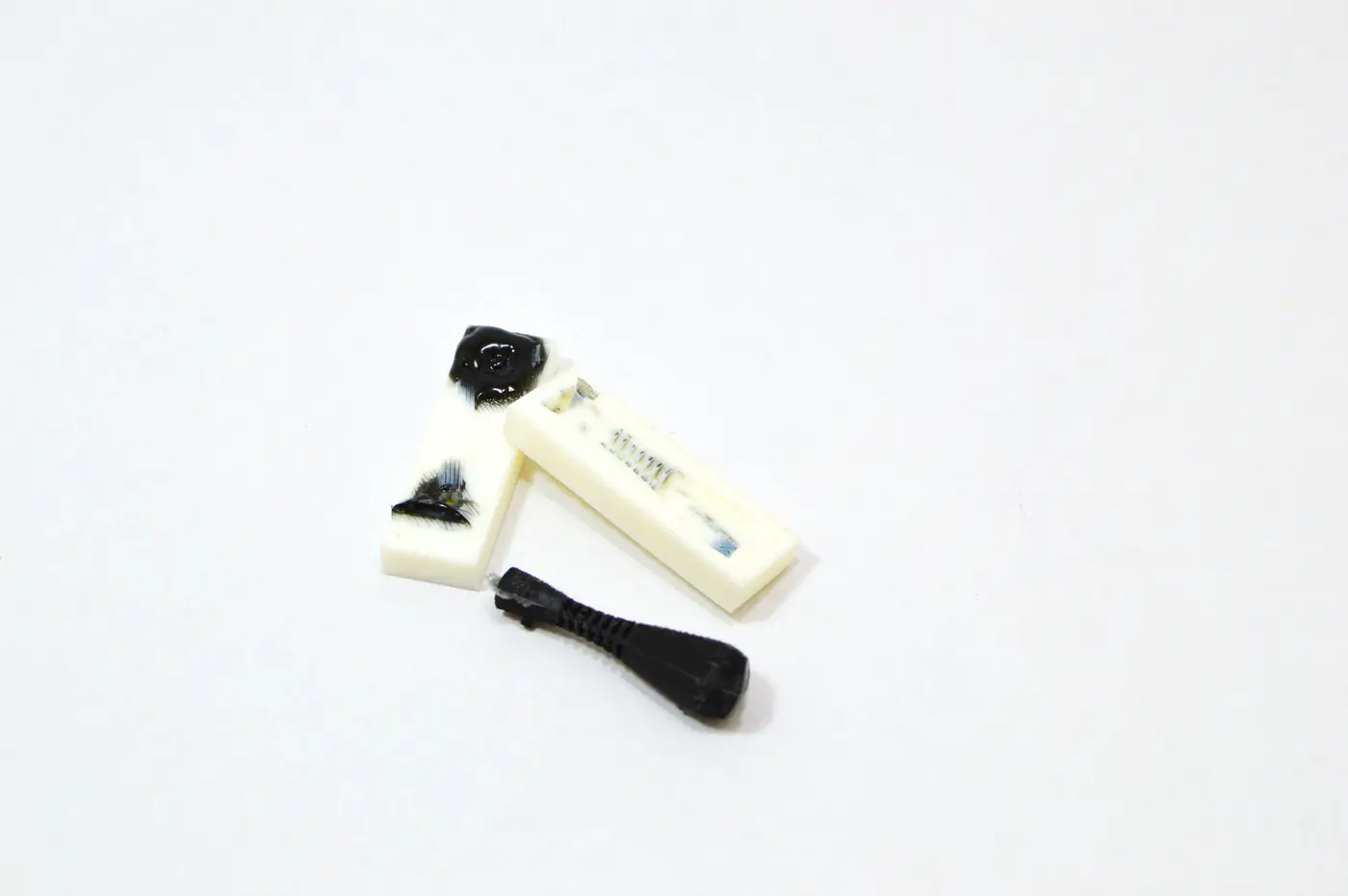
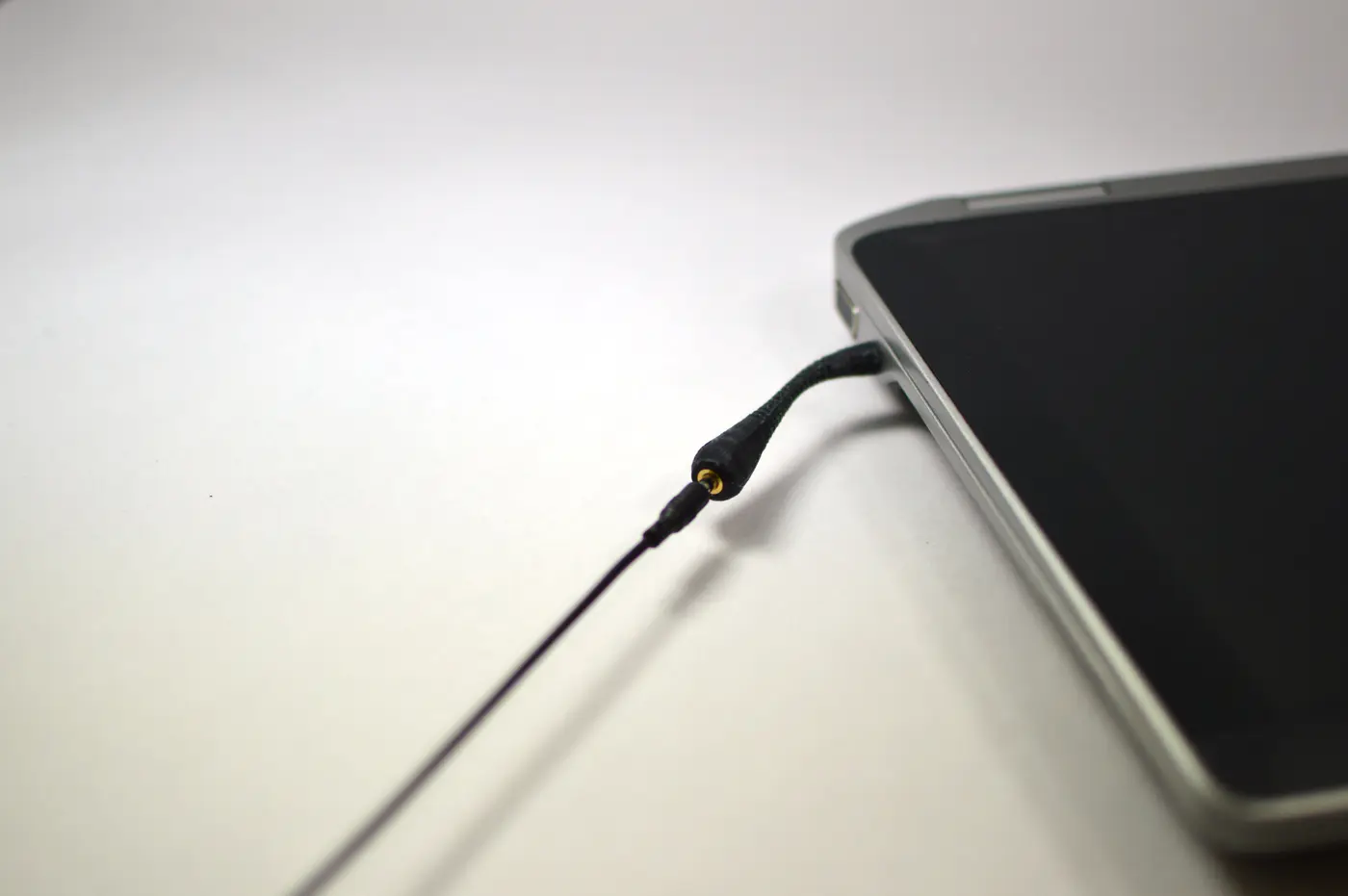
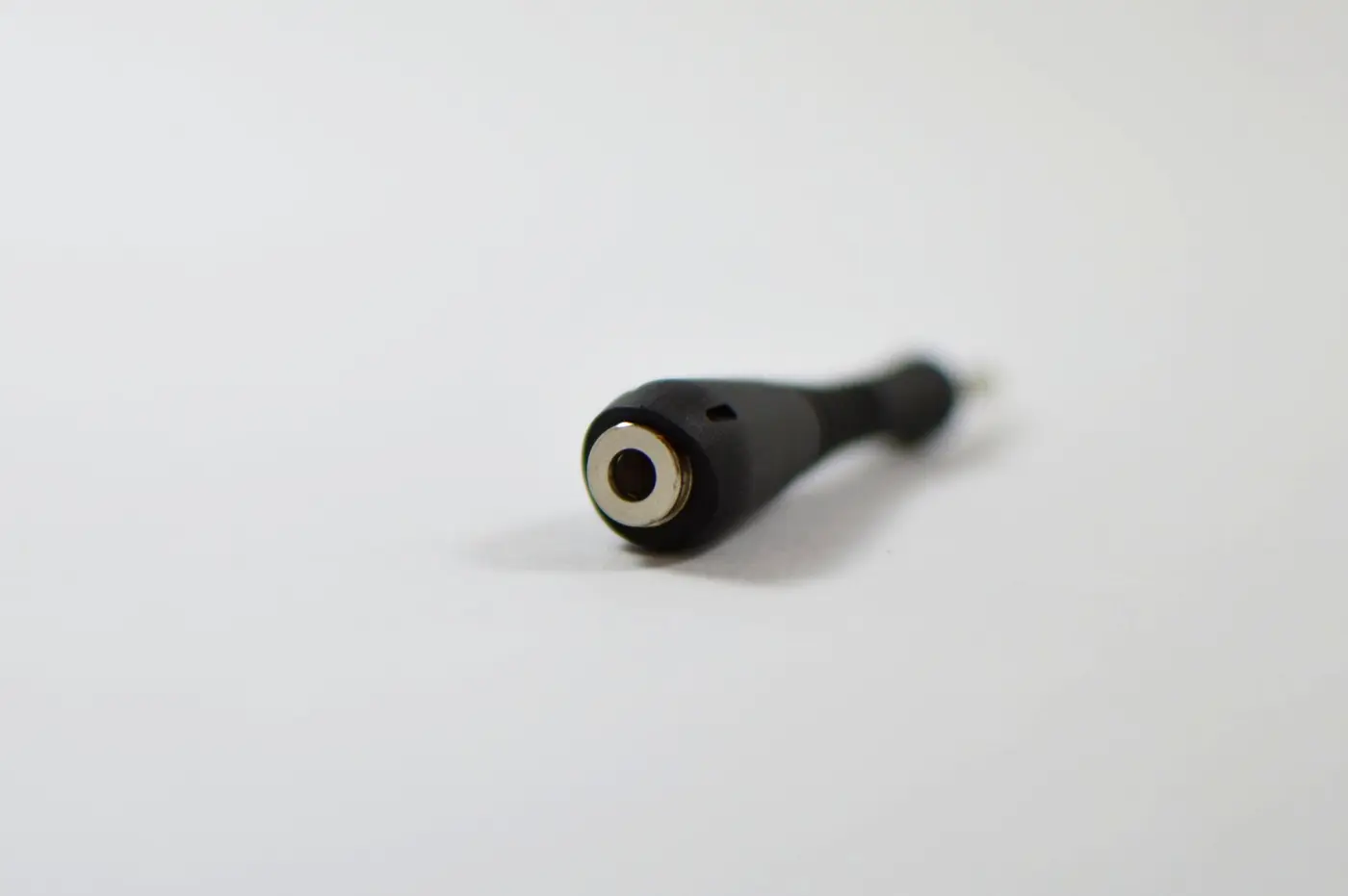
The FISHBONE moved a $70 repair out of the device and into a low-cost breakaway part, and went from concept to market in under four months.
AVID Products Inc.
The people- President, AVID Products Inc.
- Manufacturer, production factory, Guangdong, China
- Me, designer and engineer
The brief
AVID Products Inc. received a large number of headphones under RMA with 3.5 mm audio pins broken off inside the jack. A research inquiry established the cause: young students strained their headphone cords to the point of pin failure, particularly during lessons and tests. A pin removal and jack repair costs about $70, requires specialist tools and training, and the offsite service usually takes weeks.
The design problem was where the system fails. The adapter had to carry the audio signal in normal use and separate under cord strain before the load reached the pins, moving the point of failure out of the device and into a low-cost part. The design spanned four concerns: mechanical (the breakaway interface), electrical (the 3.5 mm audio path through the adapter), the user (young students in classrooms and testing sessions), and manufacturing (sustained production at millions of units per year in Guangdong, China). A short run of one hundred units takes a week; setting up sustained volume is far harder, even for a part as simple as the FISHBONE.
Verification matrix
- N1 Device owner: protect the device jack and the headphone plug from cord strain, so that a cord pull ends in a separated adapter instead of a jack repair.
- N2 Listener: carry the audio signal with no loss in quality.
- N3 Student: work for young students in classrooms and testing sessions, with no instruction and under rough handling.
- N4 School as buyer: cost a small fraction of the repair it prevents, fit the devices already in the classroom, and let staff replace a damaged unit on the spot.
- N5 Manufacturer: build at consumer-product scale with every unit equal to the approved design.
- N6 Regulator and parent: meet the U.S. safety and compliance rules for a children's product.
| ID | Need | Requirement | Method | Status |
|---|---|---|---|---|
| R-01 | N1 | The adapter shall separate under an axial cord pull at a force between 5 N and 15 N, below the force that deforms the 3.5 mm plug pin in the jack. | Test | Pass |
| R-02 | N1 | The adapter shall separate under side pull, with the cord at 90 degrees to the jack, before the plug pin yields.Failed on the first prototypes: a side pull levered the plug in the jack before the joint released. Resolved by moving the breakaway joint closer to the plug and changing its geometry, so a side load turns into separation. | Test | Pass after redesign |
| R-03 | N1 | The adapter shall stay connected under a static axial load of 2 N applied for 60 s, which exceeds the cord weight and head-movement loads of normal use. | Test | Pass |
| R-04 | N1 | The axial separation force shall stay within the R-01 range after 5,000 connect and separate cycles. | Test | Pass |
| R-05 | N1 | The plug pin and the device jack shall show no visible deformation at 10x magnification after 500 side-pull separations per R-02. | Inspection | Pass |
| R-06 | N2 | The adapter shall pass all three conductors of a stereo TRS connection (left, right and ground) across the breakaway joint. | Inspection | Pass |
| R-07 | N2 | The series resistance added by the adapter shall not exceed 0.5 ohm on each conductor. | Test | Pass |
| R-08 | N2 | The frequency response through the adapter into a 32 ohm load shall stay within 0.5 dB of a direct connection from 20 Hz to 20 kHz. | Test | Pass |
| R-09 | N2 | The signal path shall show no contact interruption longer than 1 ms while the joint flexes through plus and minus 45 degrees for 1,000 cycles. | Test | Pass |
| R-10 | N3 | At least 9 of 10 students aged 6 to 10 shall reconnect the separated halves within 10 s with no instruction. | Demonstration | Pass |
| R-11 | N3 | The connected adapter shall meet R-01 and R-07 after 10 drops from 1.0 m onto a hard floor. | Test | Pass |
| R-12 | N3 | The halves shall reconnect by hand with no tools. | Demonstration | Pass |
| R-13 | N4 | The landed unit cost to the school shall not exceed 10 percent of the jack repair cost. | Analysis | Pass |
| R-14 | N4 | The plug shall have a measured diameter of 3.5 mm, plus or minus 0.05 mm, and shall mate with the headphone jacks of a representative set of classroom laptops, Chromebooks and tablets. | Inspection | Pass |
| R-15 | N4 | A teacher shall replace a damaged adapter with no tools in less than 60 s. | Demonstration | Pass |
| R-16 | N5 | Production units shall match the approved prototype in dimensions and separation force, confirmed by first-article inspection at the factory. | Inspection | Pass |
| R-17 | N5 | Each production lot shall pass a separation-force sample inspection per ANSI/ASQ Z1.4, general inspection level II, at an AQL of 1.0. | Inspection | Pass |
| R-18 | N6 | No part shall detach in use, on separation, or after the drops of R-11 that fits within the small-parts test cylinder of 16 CFR 1501 (voluntary). | Test | Pass |
| R-19 | N6 | No accessible metal edge shall fail the sharp-edge test of 16 CFR 1500.49 (voluntary). | Test | Pass |
| R-20 | N6 | Each accessible component shall contain no more than 100 ppm total lead, per 15 U.S.C. 1278a. | Test | Pass |
| R-21 | N6 | The product shall ship with a Children's Product Certificate based on testing by a CPSC-accepted third-party laboratory. | Inspection | Pass |
Methods follow the four standard verification methods: test, analysis, inspection and demonstration. Each requirement traces to one stakeholder need. Regulatory criteria cite the governing U.S. federal rule; criteria marked as voluntary apply a rule beyond its mandatory age range.
How it unfolded
- ConceptThe breakaway concept was developed and reviewed with AVID’s president.
- Prototype and testPrototypes were built and tested.
- Production engineeringThe design was engineered for production, and manufacturing was planned.
- Factory rolloutProduction was rolled out on location at the factory in Guangdong, China.
- LaunchThe FISHBONE reached market.
What I did
- Program management and client relationsOwned the FISHBONE from conception to market launch. Brainstorming and review sessions with AVID’s president, who pressed for a faster schedule.
- Design and engineeringDesigned, prototyped, and engineered the FISHBONE.
- Testing and validationTested the FISHBONE prototypes ahead of production.
- ManufacturingManufacturing planning, working closely and on location with the production factory in Guangdong, China, to roll out the FISHBONE.
Decisions
- Breakaway adapter. Every other option considered needed heavy modification of the headphones or of the device they plug into. The FISHBONE works with any headphone that has a standard plug, and it costs little.
- Mechanism. Prototyping showed that the mechanism could be very simple and still work. It also showed that the part could be made with well-known processes in the existing manufacturing base in Guangdong.
- Mold features. Some features of the part made ejection from the mold fail more often than acceptable. A failed ejection meant manual removal, which meant downtime and a lower cycle rate. Slight changes to those features significantly reduced the ejection failures and let the factory run the production cycle at a very high rate.
Final production samples reached AVID quickly, so the marketing and sales teams could set up their systems and demonstrate the product. The FISHBONE sold rapidly and steadily from launch. RMA returns fell, and the supply of returned headphones for teardown analysis ran short.
A low-cost sacrificial component could protect a device that costs about $70 to repair, at consumer-product scale.
The costliest failures happen in the field, not on the bench. I traced this one to its cause, designed where the system should fail, and carried the design through production on the factory floor.