The New Hype
I read more and more every day about how such and such “is the future of business” or “the future of apps” or the “future of communication”. I’m sure this has always been happening but it’s only recently that this over-bloviated phrase has taken place among the everyday writings of the blog elite.
Why?
New services and products are coming to market too fast for consumers to naturally grow tired of their existing services and products. Therefore, consumers simply move on to the new and forget about the old.
The market for consumer durable goods and services is heavily trend driven and the already low barriers to entry for creation are constantly lowering. Accordingly, the level of choice in the marketplace changes, usually meaning more choice and not less, drastically from moment to moment in any given product category.From a consumer perspective, the rapid rise of desktop 3D printing is a prime indicator of both the speed and lowered barriers. From a corporate top-down perspective, New Balance optimized their product pipeline so they are now able to take a new concept from paper to market in 9 months- almost 65% faster than just a few years ago.
Classic marketing dictates that current purchasing habits are predictive of future purchasing habits; if I buy Nike running shoes now, I’m almost certainly going to buy a water bottle in the near future. Accordingly, there’s an extremely high probability that the water bottle I purchase will adhere to similar brand attributes as the Nike shoes- ergonomic, bright color pops, and serious about athletic performance. Increasingly, consumers are faced with insane levels of choice when selecting apps, music or (to a lesser extent, but especially in on-trend areas like fitness trackers or desktop manufacturing devices) hardware. This exposure forces the consumer to choose from a huge number of competing alternatives. Ever seen the hype curve?
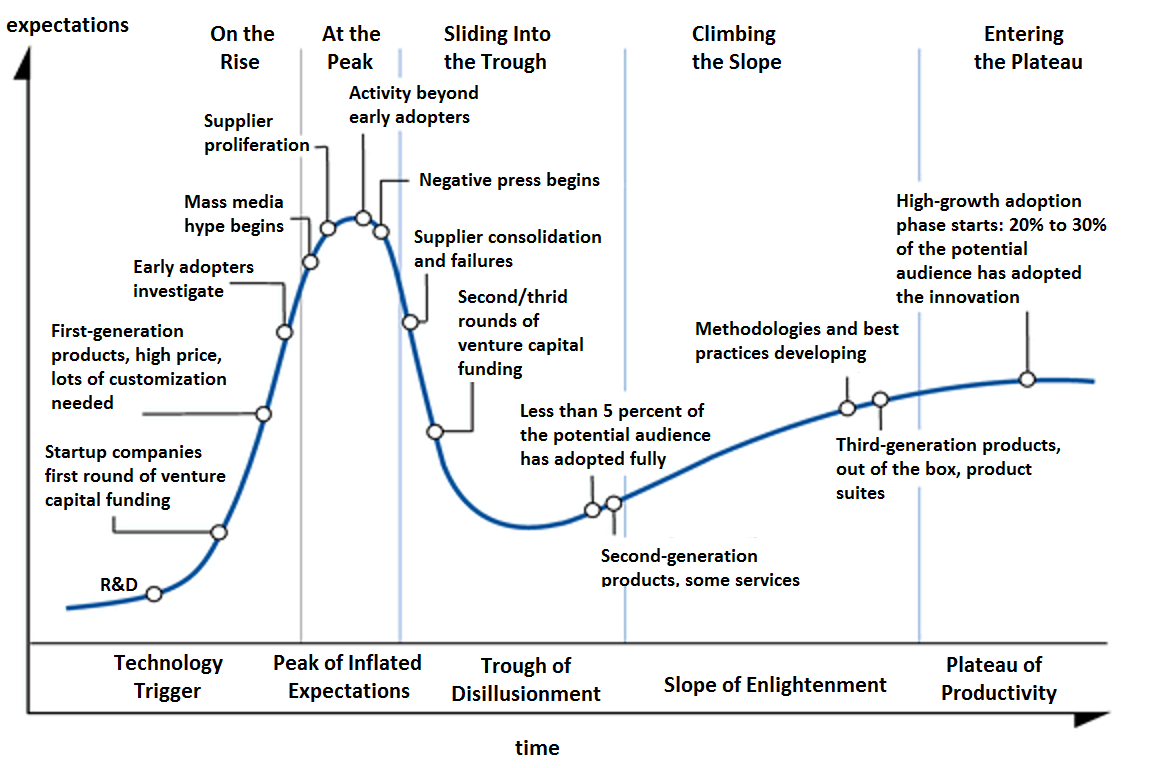
This curve is broken by the speed of modern era. Now, once the hype support for a product dies and the public eye turns to the next thing du jour, the path to adoption is over. Instead, the curve now looks a lot more like this:
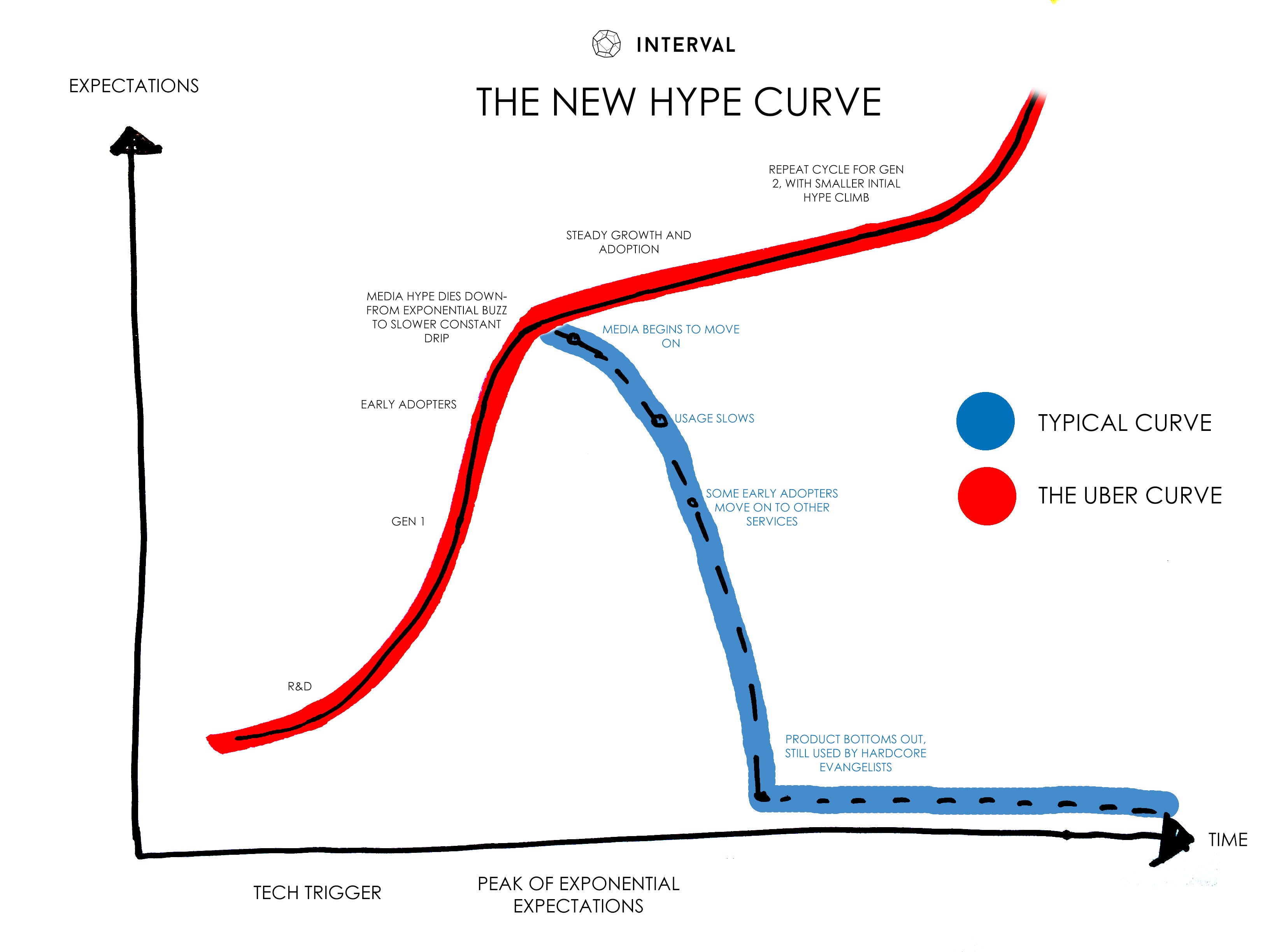
For a vast majority of apps and services and devices, the curve is blue.
Blue is a quick death.
It’s only the extremely rare product that manages to make it to the next level without bottoming out; thus the Uber (as in taxicab-replacement Uber although Makerbot, FitBit, iPhone, etc. would have worked fine) curve. Furthermore, the time during which this exponential growth occurs has compressed dramatically compared to the standard model. Instead of a year, the exponential hype (and by correlation although not necessarily exponentially so: growth) period now occurs over a month or even weeks.
Although discussing mobile gaming, TechCrunch sums up my point nicely as these principals can be applied to the larger marketplace:
Users are often playing, then disposing of, old titles in favor of new ones on a regular basis…And these days, the hit-driven nature of mobile gaming seems to be seeping over into other areas of the App Store as well, where trending, buzzed-about hits are not always of the “Flappy Bird” variety, but are sometimes just goofy apps we’ll all talk about for a few days, like Yo, then forget.
Indeed Yo was downloaded one million times in the first four days it existed on the App Store reaching as high as #3 surpassing Facebook and Snapchat. Eight days following the high, Yo dropped to #70 and has continued to fall since.
Exploiting this new curve requires constant product refresh cycles to be designed into the DNA of the product from the beginning so the hype never dies and users never leave. Keep it in the red.
Apps are incredibly good at solving this problem right out of the gate. It is expected that apps will undergo stability upgrades and backend revisions throughout their existence. Piggybacking this process to upgrade the visible user experience or core functionality of the app is not only easy, but expected. The power of the ease of upgradability is double sided however; upgrade too far and existing consumers become upset that what they know is completely different but under-deliver or deliver infrequently and consumers feel like they are being left behind.
Designing this refresh cycle into a physical product is far more difficult but certainly possible. Tesla accomplishes this by pushing over-the-air (OTA) updates out to all the software packages that run each Model S they produce. These updates tangibly augment the physical characteristics of the car; older base Model S units are now faster zero to sixty than they were when purchased. Furthermore, Tesla designed in a hidden environmental sensor system knowing that they would be able to produce an algorithm at some point in the future to allow for semi-autonomous driving. This type of foresight is difficult to achieve and can be costly but the benefit is massive if done correctly. Imagine the delight of a Model S driver when they realize that, after an invisible update, their car is noticeably better than when they first fell in love with it!
However, this effect is not solely achievable via digital means. Smart engineering and design on the part of Makerbot, the leading consumer 3D printer manufacturer, allowed for the production of a machine that is capable of extruding multiple types of plastic filaments with differing physical properties. These filaments drastically expand the usability of the device and were introduced slowly as the base unit itself aged. Similarly, they offer some hardware upgrades to the base unit allowing for swaps of key components. By doing so, the printer feels fresh.
Even then, the Makerbot printer is still a technology product. What about a simpler product?
I bet you have a lamp. I bet you’ve had that lamp for a really long time. You probably aren’t going to replace it any time soon despite the fact that there are many lamps on the market. Why not? As much as you may touch the lamp to turn it on or angle the shade, the lamp is not the product that is truly important to you; it’s the light bulb inside. The light bulb is the built-in refresh cycle that the lamp needs to stay current. When your incandescent bulb burns out, you have the option to refresh it with a virtually unlimited number of bulb options ranging from electricity-sipping LED units to specialty halogens that perfectly emulate the natural light color of the sun. Although most bulb companies aren’t producing lamps and vice versa, both bulb and lamp companies symbiotically benefit from this built-in refresh cycle because both products are built around a standard socket size. To be clear, there is definitely increased risk from competition in building to standards-especially self-created standards- but there’s also opportunity to tie into a larger presumably healthy market. Balance in all things.
Don’t attempt to beat the curve by designing an incremental upgrade and marketing it as a completely new product. It weakens the brand lineage and exposes the product to undercutting competitors.
Traditional razor companies are built on the model of evolutionary incrementalism. They incrementally upgrade either the razor handle or the blade with a lot of self-driven hype via huge media buys. Accordingly, they are under constant attack from upstarts like subscription-service Dollar Shave Club and bulk-seller Dorco. These younger, more nimble companies are beating established giants by offering novel pricing models and comparable quality blades and handles for less money. Dorco and especially Dollar Shave Club market their products by portraying older competitors as lumbering behemoths bent on screwing over consumers.
Are Dorco and Dollar Shave Club’s claims true? Realistically, it doesn’t matter. Their message resonates because years of incrementalist production practices and a reliance on the methodologies driven by the standard hype curve have given the public the idea that larger razor competitors are selling products in an irresponsible manner.